

Today’s story is the answer to the March 2026 puzzler.
Though Ireland is known for the many shades of green that grace its grassy pastoral landscapes, there’s one corner of the Emerald Isle where gray reigns supreme. In the Burren region, on the island’s west coast, what geologists describe as limestone pavement covers much of the rocky, treeless landscape.
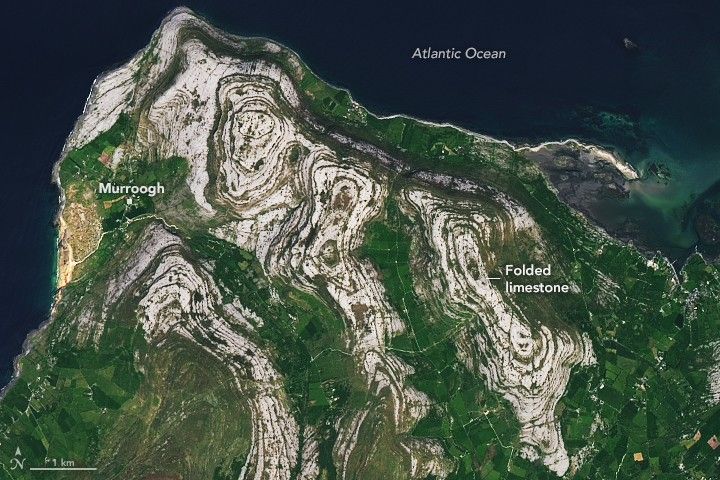
The OLI (Operational Land Imager) on Landsat 8 captured this view of the Burren on May 16, 2025. The fossil-rich limestone that makes up the gray outcrops was deposited about 325 million years ago during the Carboniferous Period, when what is now Ireland lay near the equator beneath warm, shallow seas. Although the limestone was initially deposited in flat, horizontal layers on the seafloor, it later buckled into gentle arch- and trough-shaped folds as tectonic plates collided during a mountain-building episode known as the Variscan Orogeny.
These folds in the tilted rock layers and differences in their rate of erosion produced the terraced appearance that defines the Burren’s hills, with more erosion-resistant layers of rock persisting as ledges. Glacial activity also played a role in sculpting the landscape, scraping away soil and sediment to expose the limestone pavement and smoothing the region’s hills.

Limestone is prone to chemical weathering that produces an irregular terrain known as karst, pockmarked with sinkholes, caves, and fissures called grikes. Many grikes in the Burren collect soil and have become footholds where vegetation grows in the otherwise rocky landscape.
Individual grikes are too small to see in Landsat imagery, but networks of them have aligned along the rock layers, contributing to the concentric vegetation patterns visible in the image. Among the plants that you might find growing in them is the shamrock, the three-leaved clover that has become a symbol of Ireland.
With some luck, Trifolium dubium or Trifolium repens may even be found amidst the shamrock-shaped contours of Moneen Mountain, a 262-meter (860-foot) limestone hill visible in the image above. While there’s hardly consensus about what species is the true inspiration for shamrocks, these two clover species were among the favorites when Irish botanists were surveyed about the topic in the 1880s, according to the Carnegie Museum of Natural History.
NASA Earth Observatory images by Lauren Dauphin, using Landsat data from the U.S. Geological Survey. Story by Adam Voiland.
Downloads

References & Resources
- Burren and Cliffs of Moher Geopark The Story of the Burren. Accessed March 16, 2026.
- Burren National Park Nature & Conservation. Accessed March 16, 2026.
- Carnegie Museum of Natural History What is a Shamrock? Accessed March 16, 2026.
- Earth (2018, June 7) Travels in Geology: The Burren: Ireland’s “Great Rock” Region. Accessed March 16, 2026.
- The Geological Society The Burren. Accessed March 16, 2026.
- International Commission on Geoheritage (2026) Carboniferous evolution of the Burren and Cliffs of Moher. Accessed March 16, 2026.
- National Geographic (2024, October 10) Come to this Irish region for otherworldly rock formations. Accessed March 16, 2026.
- Smithsonian (2016, March 16) No One Really Knows What a Shamrock Is. Accessed March 16, 2026.
You may also be interested in:
Stay up-to-date with the latest content from NASA as we explore the universe and discover more about our home planet.
The colorful formations found in this bowl-shaped escarpment in southwestern Utah are the centerpiece of Cedar Breaks National Monument.

Over millions of years, water has sculpted limestone in northern Vietnam into an extraordinary karst landscape full of towers, cones,…

Satellites are helping land managers track ecological shifts as reserves reconnect and landscapes return to a more natural state.




The post A Bit of Gray on an Emerald Isle appeared first on NASA Science.
About Author