



October 30, 2022
March 25, 2024
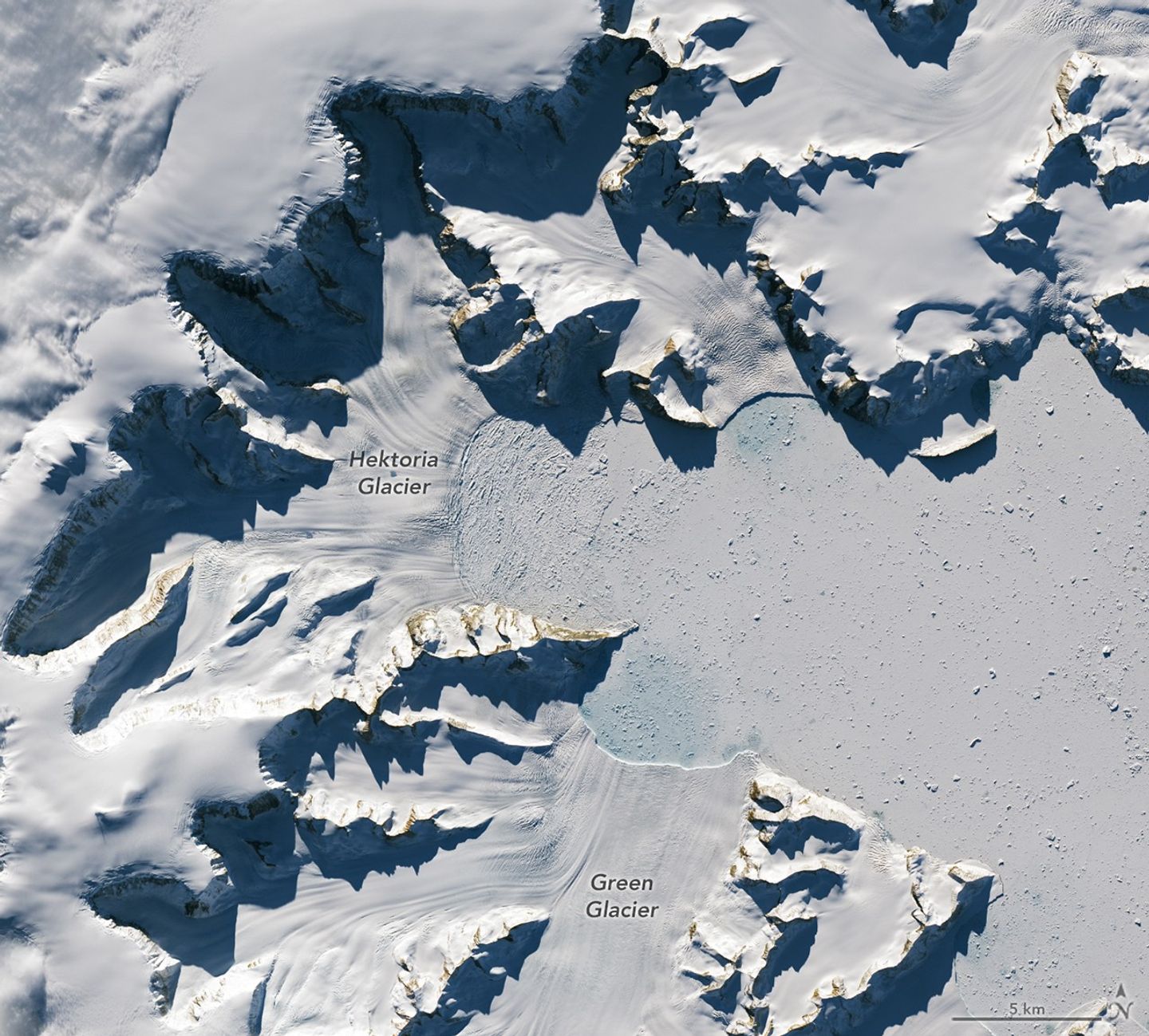
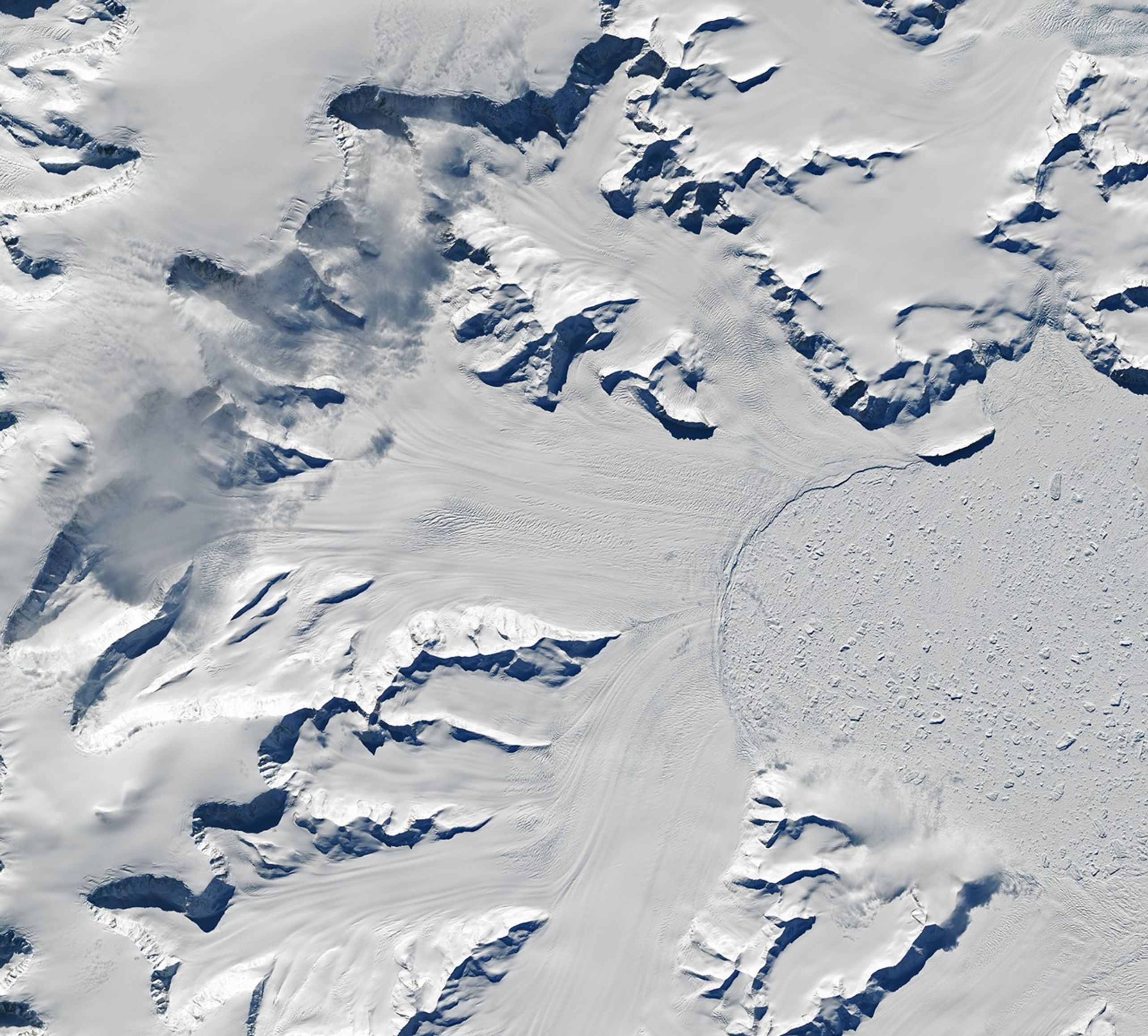
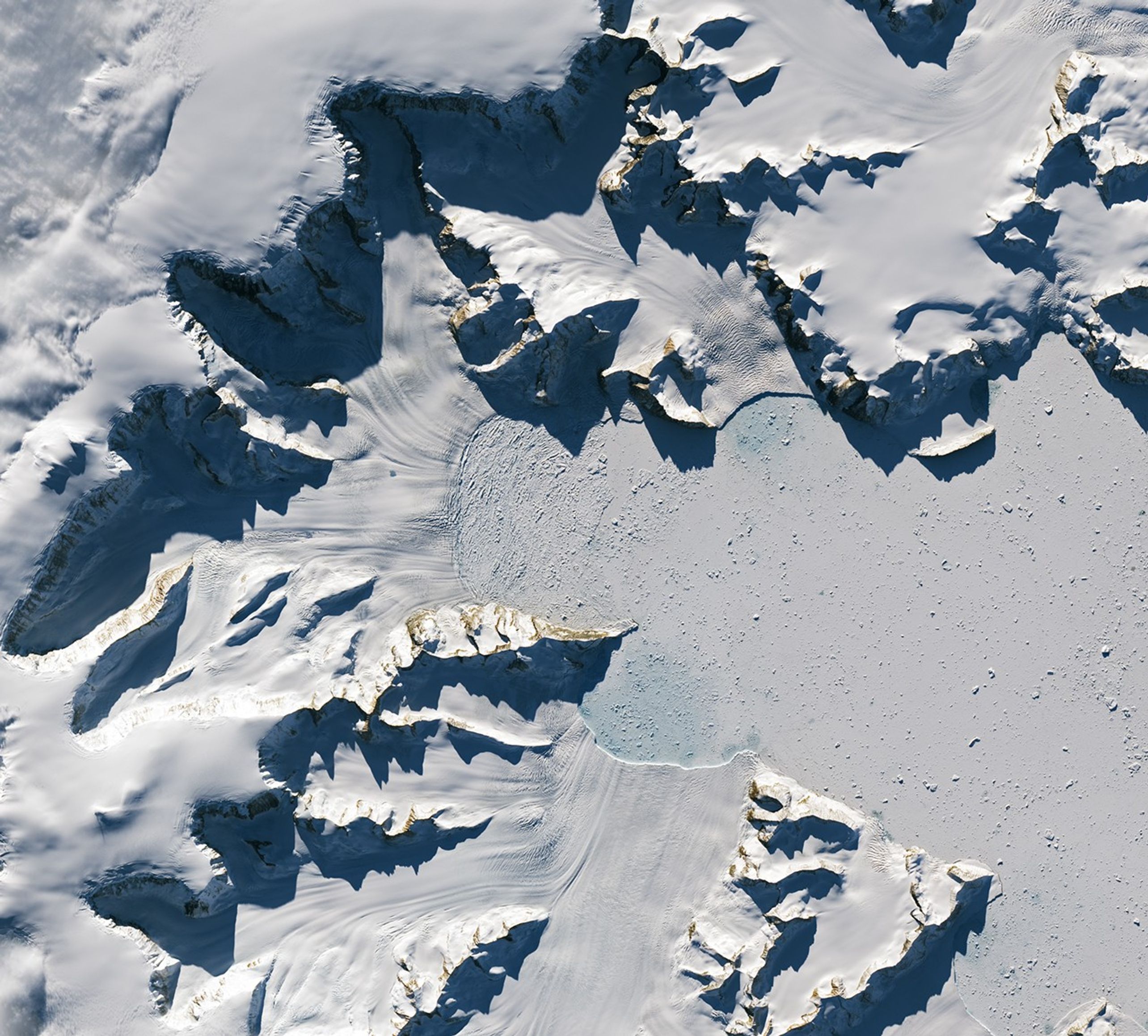
To say something moves at a glacial pace is to imply sluggish, unhurried change. But what transpired over the course of 15 months at Antarctica’s Hektoria Glacier was uncharacteristically quick. Between January 2022 and March 2023, the glacier lost about 25 kilometers (15 miles) in length. That included a two-month period in which the terminus retreated more than 8 kilometers (5 miles)—the highest rate of grounded glacial ice loss observed in modern history.
A team of scientists published an analysis of Hektoria’s collapse based on a suite of remote-sensing data, finding that its particular geometry enabled the rapid change. Like many glaciers on the Antarctic Peninsula, Hektoria starts on land and extends to the sea, with the last section being a thick, floating plate of ice, or “ice tongue.” The researchers determined Hektoria lost both its ice tongue and an area of grounded ice spread over a flat plain—the latter directly contributing to sea level rise. Although Hektoria is relatively small as Antarctic glaciers go, scientists say that similar events at larger glaciers could be much more consequential.
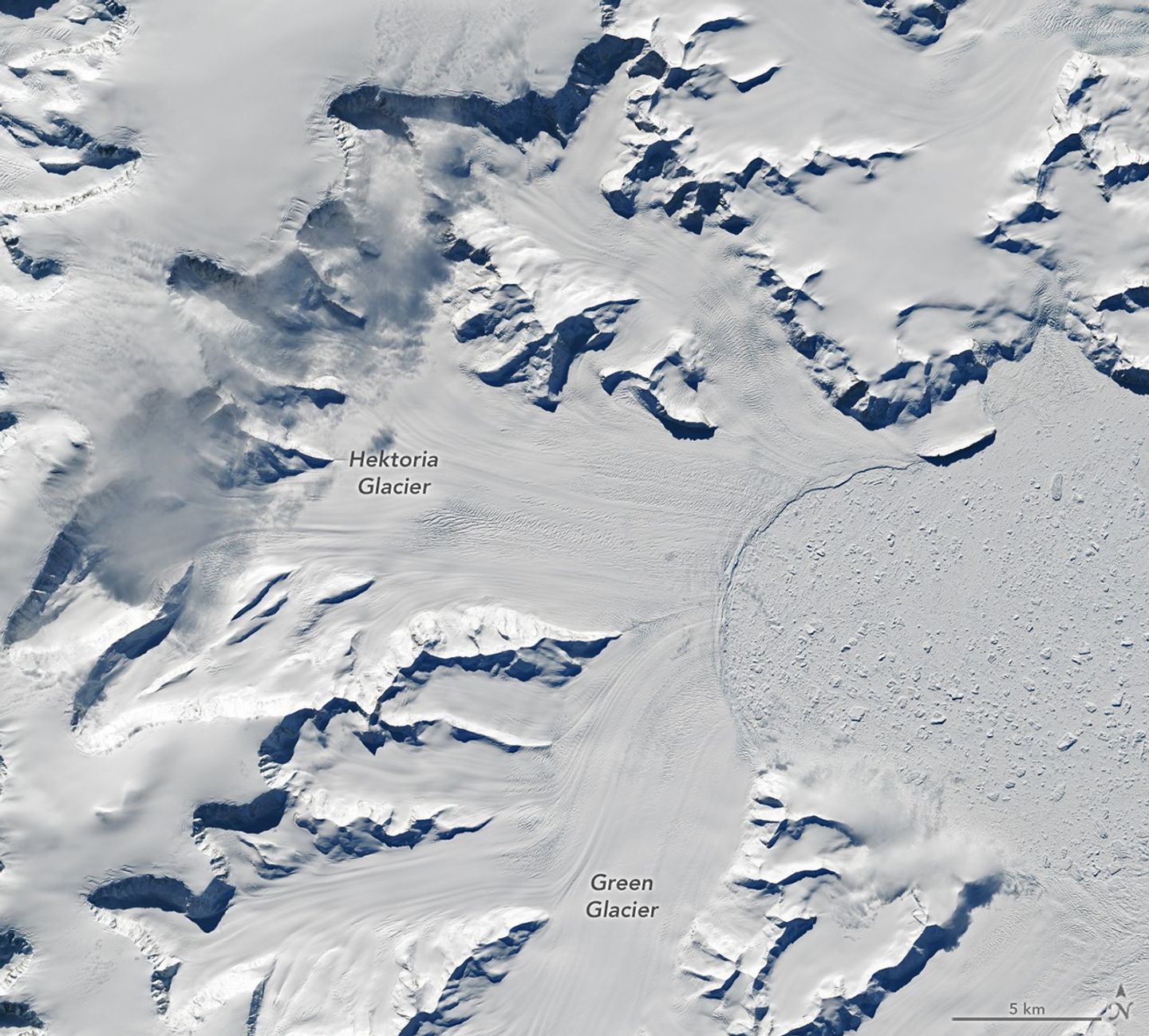
The images above capture the scale of the loss of Hektoria’s grounded ice on the eastern Antarctic Peninsula. Note that the right image was acquired about one year after the remarkable loss of grounded ice; a cloud-free Landsat image showing the whole area was not available from the previous March. Hektoria’s terminus remained relatively stable after the sudden loss, the study reported, though the neighboring Green Glacier continued to retreat.
The chain of events culminating in Hektoria’s breakup goes back to early 2002. At that time, the Larsen B ice shelf, which served as a backstop for Hektoria and neighboring glaciers, splintered and collapsed in short order. The glaciers then thinned and retreated for several years. In 2011, landfast sea ice in the Larsen B embayment near Hektoria’s terminus filled in enough to allow the glacier to start advancing.
But after several years, the new support for the glacier front was suddenly removed. Landfast ice in the embayment broke up in January 2022, likely due to large, destabilizing ocean swells. From that point, rapid change at Hektoria was again underway. Throughout the rest of the austral summer, the floating ice tongue disaggregated in a series of calvings, resulting in a loss of 16 kilometers.
The glacier’s terminus stabilized during the 2022 austral winter. However, satellite-based laser altimetry data, including ice elevation measurements from NASA’s ICESat-2 (Ice, Cloud, and Land Elevation Satellite-2) mission, revealed that the ice continued to thin during that winter.
The thinner remaining ice was still grounded during the 2022 austral spring (left image, above), the study authors concluded, based on the detection of earthquakes occurring beneath the glacier. They determined the ice was spread out over a relatively flat area of bedrock, forming an ice plain. This geometry allows seawater to infiltrate the glacier’s bed during high tide and intermittently lift ice off the ground. When ice is thin enough, large areas can lift and break away at once. The process, called buoyancy-driven calving, is believed to have caused the second stage of Hektoria’s rapid retreat, resulting in an additional loss of 8 kilometers in length.
New platforms, such as the NISAR and SWOT satellites developed by NASA and partners, may aid in understanding rapid changes in glaciers.
Naomi Ochwat, a glaciologist at the University of Innsbruck and the study’s lead author, is now looking into other glaciers that may be at risk of destabilizing in a similar way. As the Antarctic Peninsula responds to warming, more of its glaciers are losing their ice tongues, and their termini are now resting on the seabed, as Hektoria’s does. (Called tidewater glaciers, this type is common in Alaska and Greenland.) New technologies developed by NASA and partners can aid in understanding rapid glacial retreat, said Ochwat and study co-author Ted Scambos, a senior research scientist at the University of Colorado Boulder.
The NISAR (NASA-ISRO Synthetic Aperture Radar) satellite, for example, can detect the movement of land and ice surfaces down to the centimeter. Its data will be “very useful for structural evaluations of Hektoria and other glaciers in the region,” Scambos said.
“In addition to NISAR,” Ochwat added, “I’m particularly interested in learning what SWOT can tell us about rapid glacier changes.” The SWOT (Surface Water and Ocean Topography) satellite’s primary mission is to observe the fine details of Earth’s surface water height. But scientists are also exploring its applications to the cryosphere, such as measuring surfaces of ice shelves and sea ice.
At Hektoria Glacier, the days of dramatic change are likely past, now to be replaced by slow retreat. Scambos said he would not be surprised to see the ice slowing down. “The glacier has lost so much elevation and mass that it simply can’t continue to maintain the same output,” he said. “It’s on its way to being a fjord, not a glacier.”
References & Resources
- AntarcticGlaciers.org (2022, July 2) Tidewater Glaciers. Accessed April 30, 2026.
- CIRES (2025, November 3) Antarctic glacier retreated faster than any other in modern history. Accessed April 30, 2026.
- NASA Earth Observatory (2022, February 2) Larsen B Embayment Breaks Up. Accessed April 30, 2026.
- NASA Earth Observatory (2002) World of Change: Collapse of the Larsen-B Ice Shelf. Accessed April 30, 2026.
- Ochwat, N., et al. (2025) Record grounded glacier retreat caused by an ice plain calving process. Nature Geoscience, 18, 1117–1124.
- Ochwat, N.E., et al. (2024) Triggers of the 2022 Larsen B multi-year landfast sea ice breakout and initial glacier response. The Cryosphere, 18, 1709–1731.
You may also be interested in:
Stay up-to-date with the latest content from NASA as we explore the universe and discover more about our home planet.
The glacier in southeastern Svalbard pulses with the changing seasons, speeding up and slowing its flow toward the sea.

A network of meltwater lakes and drainage channels made an Antarctic ice shelf known for its blue ice areas even…
Nearly 50 years ago, the first Landsat satellite captured the rare sight of Mid-Atlantic waterways frozen over.




The post Record-Setting Retreat of Hektoria Glacier appeared first on NASA Science.
About Author