
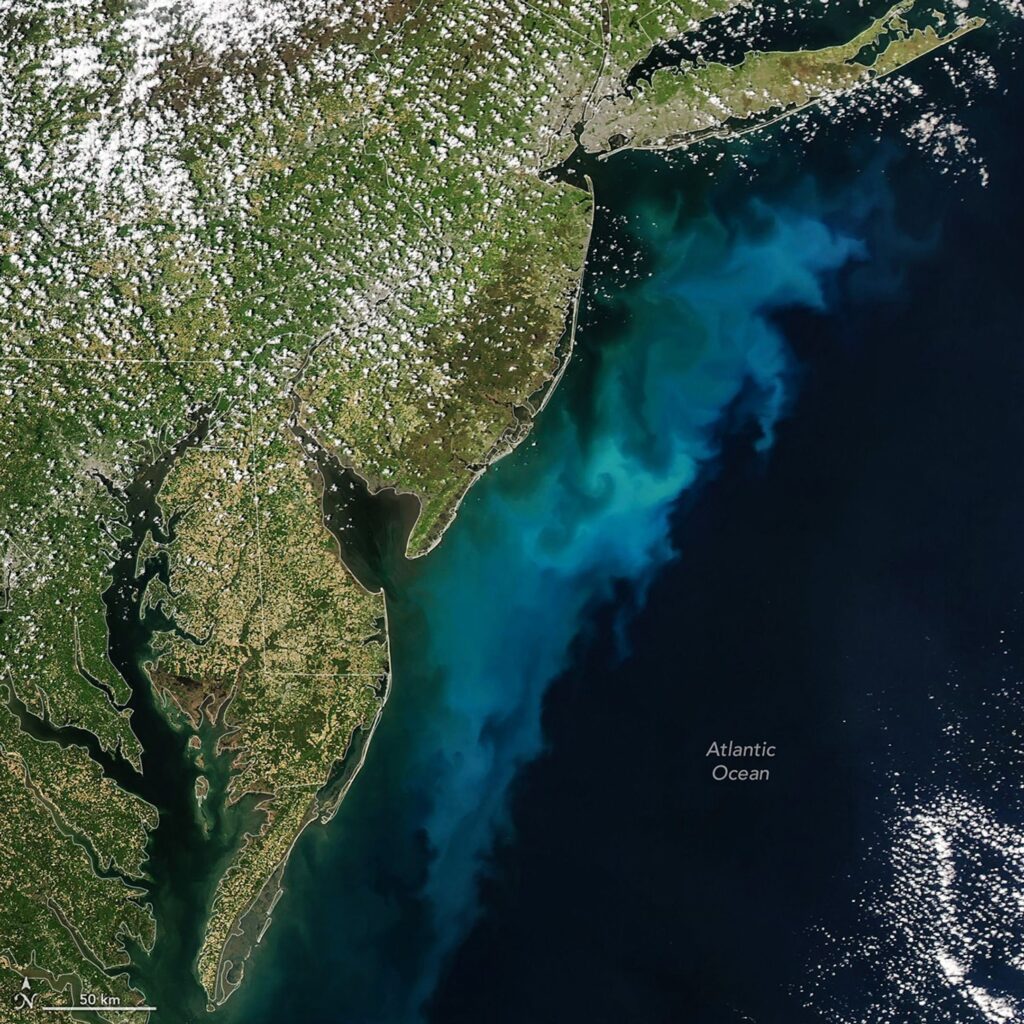
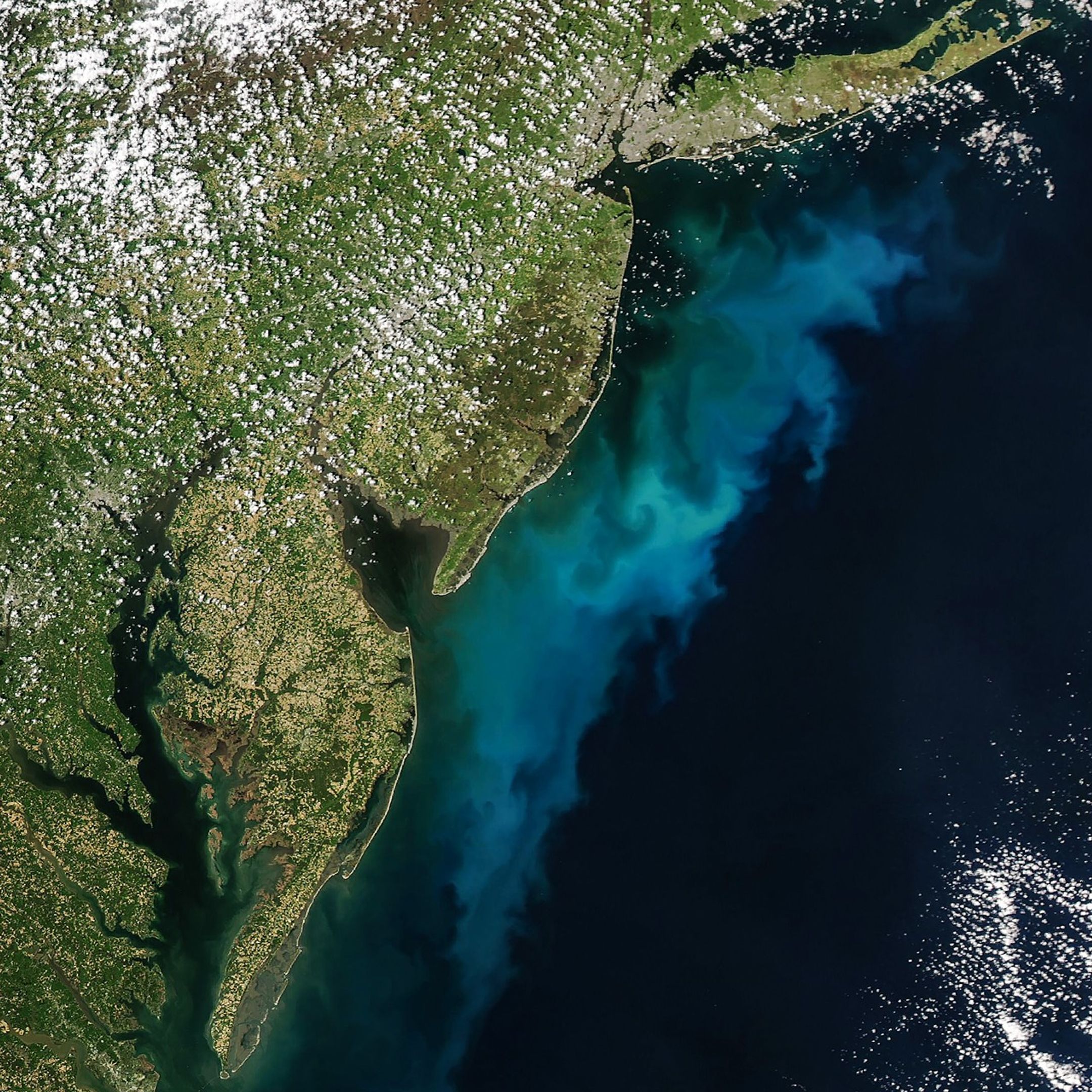
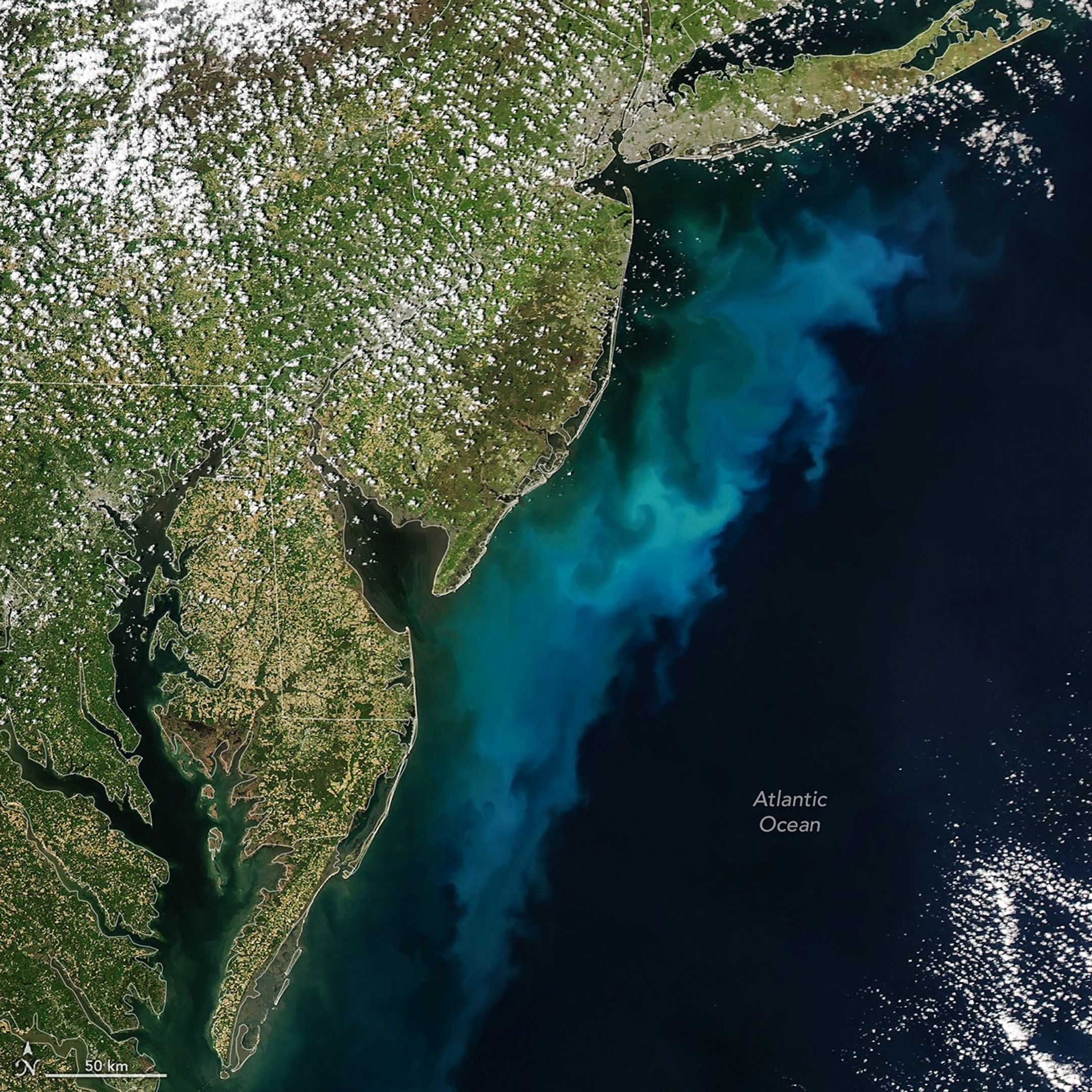
Starting in early April, NASA satellites began to detect a patch of brownish, blue-green water lingering off the coasts of New Jersey, Delaware, Maryland, and Virginia. The colors and patterns were most intense in the shallow coastal zone where the waters of Raritan Bay, Delaware Bay, and Chesapeake Bay merged with the Atlantic Ocean—an area known as the Mid-Atlantic Bight.
It’s a part of the ocean that remote sensing scientists typically describe as being “noisy” or “dirty” because rivers often discolor coastal waters with plumes of suspended sediment, water stained with colored dissolved organic matter, and an array of microscopic and aquatic plant life. All of this can mingle with ephemeral phytoplankton blooms, sometimes in mucky waters against a varied backdrop of seagrass, sand flats, and rocky sea bottoms.
This mix creates optical complexity that has long made it harder for scientists to distinguish and categorize phytoplankton blooms in shallow coastal zones compared to the deeper, darker, more uniform waters of the open ocean. Yet with the arrival of missions like PACE (Plankton, Aerosol, Cloud, Ocean Ecosystem), which launched in 2024 and measures more wavelengths of light than previous ocean color missions, scientists are growing increasingly confident in identifying phytoplankton blooms even in optically complex coastal areas.
Multiple NASA satellites—including PACE, Aqua, and Terra—have captured images of colorful water in recent weeks. While some of the color visible in the images may be due to outflows from coastal rivers and sediment churned up by spring storms, “there are likely phytoplankton blooms happening,” said Anna Windle, a research scientist at NASA’s Goddard Space Flight Center supporting the PACE science team. “Diatoms typically dominate blooms early in the spring, but we are seeing some signs of coccolithophores mixed in as well,” she said. PACE data helped confirm that at least some of the greens and blues offshore are phytoplankton blooms by mapping chlorophyll in the region on the same day.
Diatoms are a class of phytoplankton that often experience explosive growth in their population in the spring when the combination of river runoff, increased sunlight, and seasonal shifts in winds and currents brings upwellings of cool, nutrient-rich water to the surface. Diatom-dominated blooms typically appear greenish in natural-color satellite imagery.
Coccolithophore-dominated blooms generally have a brighter, chalkier, more turquoise look to them. The milky appearance is a product of the coccolithophores—tiny plant-like organisms that live in the upper layers of the ocean and surround themselves with scaly platings called coccoliths made of calcite, or calcium carbonate.
These highly reflective hubcap-shaped scales are only a few thousandths of a millimeter thick, but coccolithophores are found in such massive numbers during blooms that their plates play a key role in global biogeochemical cycles. The organisms are responsible for about one-half of modern precipitation of calcium carbonate in the ocean, according to one estimate. Off the Mid-Atlantic, coccolithophore blooms generally occur in the late spring or summer, after surface water temperatures have warmed and diatom blooms have lowered nutrient levels somewhat.
Phytoplankton are to the ocean what grasses and ground cover are to land: primary producers, a key food source for other life, and the main carbon recyclers for the marine environment. Diatoms, coccolithophores, algae, and other forms of phytoplankton are floating organisms that absorb sunshine, sponge up nutrients such as nitrogen and phosphorus, and create their own food through photosynthesis.
The ocean surface is typically quite nutrient-rich in the spring after cold winter weather and winds have mixed the water vertically, bringing nutrients upwards. “But over time, as big spring phytoplankton blooms grow, they deplete the nutrients,” said Rutgers University oceanographer Oscar Schofield. “Unless big river outflows or storms replenish the nutrients, we’ll likely see this bloom start to decline in the coming weeks.”
NASA Earth Observatory image by Michala Garrison, using MODIS data from NASA EOSDIS LANCE and GIBS/Worldview. Story by Adam Voiland.
References & Resources
- NASA (2026) Phytoplankton Exploration. Accessed May 7, 2026.
- NASA Earthdata (2026, April 2) Spring Has Sprung in the Northwest Atlantic. Accessed May 7, 2026.
- NASA Earth Observatory (2025, December 8) What are Phytoplankton? Accessed May 7, 2026.
- NASA Earth Observatory (1999, April 26) What is a Coccolithophore? Accessed May 7, 2026.
- NASA Worldview (2026, May 3) Corrected Reflectance/Chlorophyll a. Accessed May 7, 2026.
- ScienceDirect (2025) Coccolithophore. Accessed May 7, 2026.
You may also be interested in:
Stay up-to-date with the latest content from NASA as we explore the universe and discover more about our home planet.
As Iceberg A-23A disintegrated, it shed meltwater that helped fuel an extensive phytoplankton bloom in the South Atlantic Ocean.
A vibrant display of phytoplankton encircled the remote New Zealand islands.
Vivid green blooms form, drift, and fade in Hartbeespoortdam reservoir over the course of a year.




The post Color Off the Mid-Atlantic Coast appeared first on NASA Science.
About Author