

NASA Analysis Shows La Niña Limited Sea Level Rise in 2025
NASA/JPL-Caltech
Description
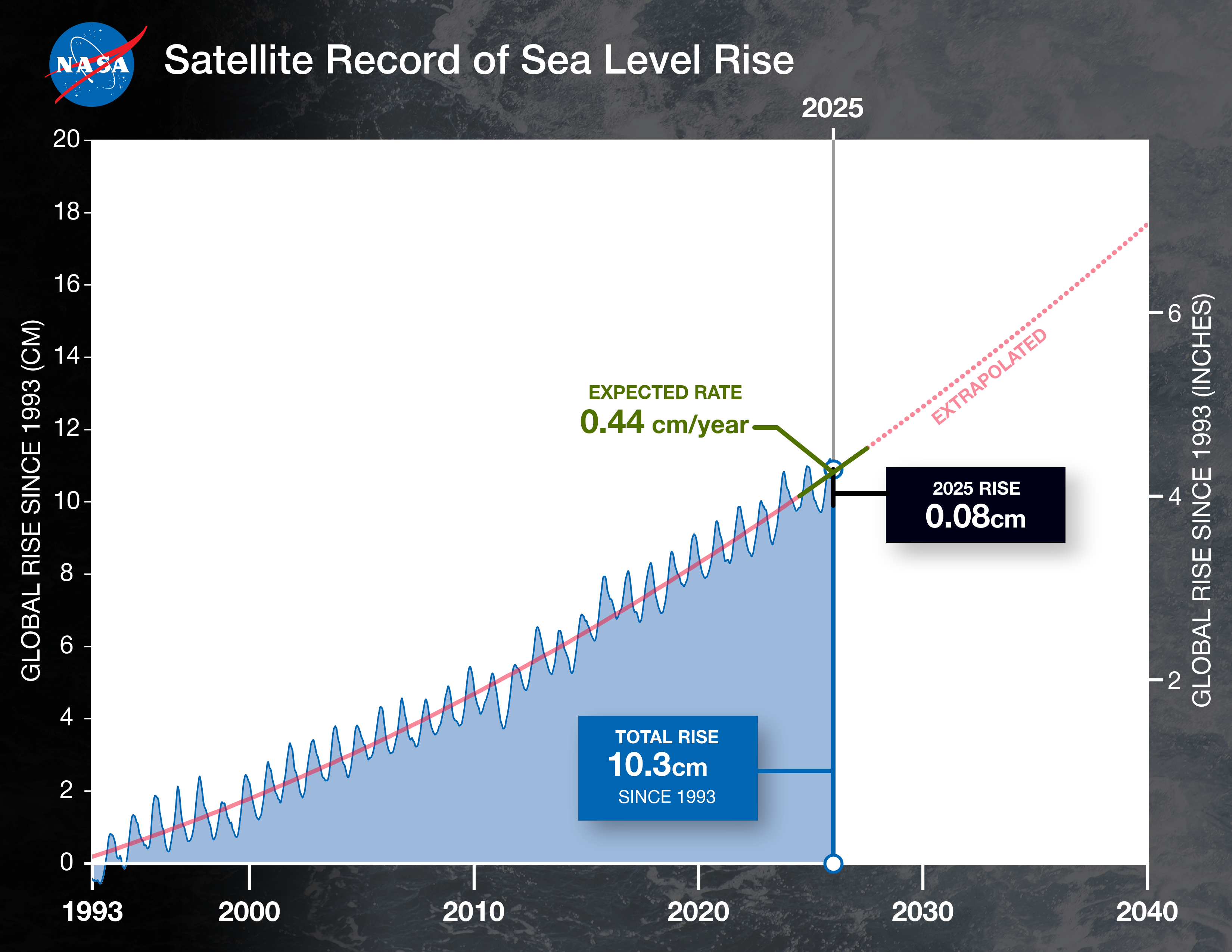
This graph shows the rise in global mean sea level from 1993 to 2025 based on data from a series of five international satellites. The solid red line indicates the trajectory of this increase, which has more than doubled over the three decades. The dotted red line projects future sea level rise.
A NASA analysis found that the average height of Earth’s oceans increased by 0.03 inches (0.08 centimeters) in 2025, a rate of increase that was lower than the 0.23 inches (0.59 centimeters) seen in 2024. It was also below the long-term expected rate of 0.17 inches (0.44 centimeters) per year based on the rate of rise since the early 1990s.
Though sea levels have increasingly trended upward, years during which the rise in the average height was less usually have occurred during La Niñas — the part of the El Niño-Southern Oscillation cycle that cools the eastern Pacific Ocean, often leading to heavy rainfall over the equatorial portions of South America.
The La Niña that started in 2025 and has extended into early 2026 has been relatively mild. Even so, the extra precipitation it has poured on the Amazon River basin contributed to an overall shift of water from ocean to land. This effect tends to temporarily lower sea levels, offsetting the rise caused by melting glaciers and ice sheets and warming of the oceans, which raises the sea levels through the expansion of water when the temperature increases. The net result in 2025 was a lower-than-average sea level rise. Faster-rising sea levels are likely to resume as the extra water in the Amazon basin makes its way to the oceans.
Researchers at NASA’s Jet Propulsion Laboratory in Southern California conducted the analysis based on more than 30 years of satellite observations, starting with the U.S.-French TOPEX/Poseidon mission, which launched in 1992, through the Sentinel-6 Michael Freilich mission, which launched in November 2020 and is the current reference satellite for sea level measurements. Sentinel-6B, which launched in November 2025, will take over for its predecessor after a cross-calibration period.


The post NASA Analysis Shows La Niña Limited Sea Level Rise in 2025 appeared first on NASA Science.
About Author