Skip to content
On the Weather

On the Weather

The Natural World in Beauty and Chaos

  • Home
  • About OTW
  • Privacy Policy
  • OTW Affiliates
  • Contact
Weather Blog
  • Home
  • All Regions
  • Weather Blog
  • A School of Mud Volcano Islands in Azerbaijan
  • Weather Blog

A School of Mud Volcano Islands in Azerbaijan

A School of Mud Volcano Islands in Azerbaijan
  1. Science
  2. Earth Observatory
  3. A School of Mud Volcano…
  • Earth
  • Earth Observatory
  • Image of the Day
  • EO Explorer
    • All Topics
    • Atmosphere
    • Land
    • Heat & Radiation
    • Life on Earth
    • Human Dimensions
    • Natural Events
    • Oceans
    • Remote Sensing Technology
    • Snow & Ice
    • Water
    • Collections
    • Global Maps
    • World of Change
    • Articles
    • Notes from the Field Blog
    • Earth Matters Blog
    • Blue Marble: Next Generation
    • EO Kids
    • Mission: Biomes
    • About Us
    • Subscribe
    • 🛜 RSS
    • Contact Us
  • Search
 
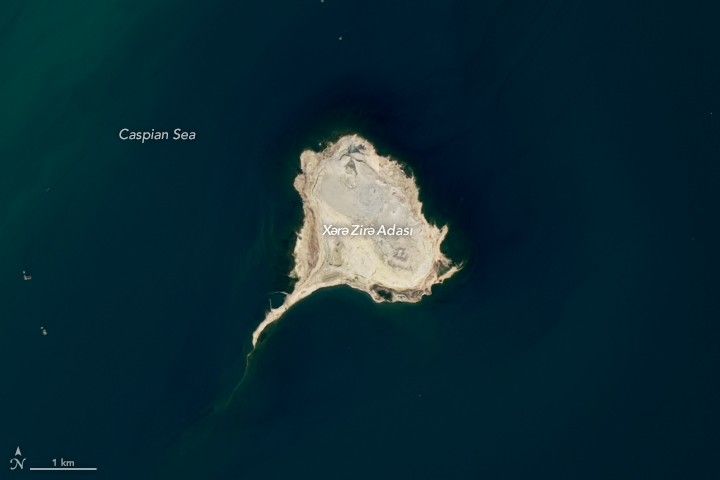
Satellite view of a tadpole-shaped brown land area encircled by blue-green water.
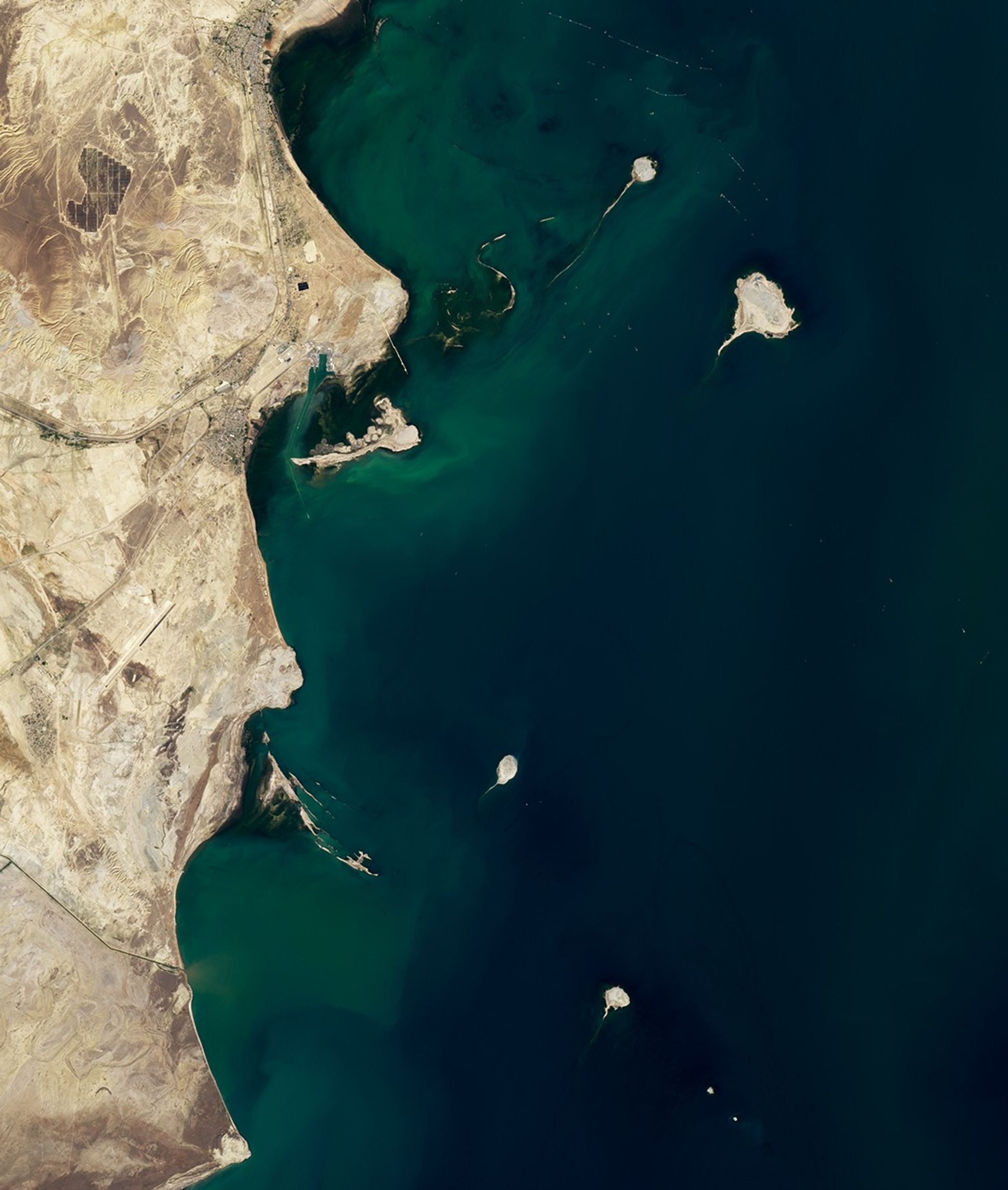
Long spits of muddy sediment are visible behind islands created by mud volcanoes in an image captured on August 30, 2025, by the OLI (Operational Land Imager) on Landsat 8.
NASA Earth Observatory/Lauren Dauphin

Today’s story is the answer to the April 2026 puzzler.  

With its abundance of naturally occurring gas seeps and fires, Azerbaijan has long been called “the land of fire.” Yet burning mountains are just one of the geologic wonders found in the small Eurasian country on the Caspian Sea.

Azerbaijan is also home to at least 220 mud volcanoes, according to data from the Azerbaijani government, though some researchers put the total number closer to 350. That is thought to be one of the highest concentrations of mud volcanoes on Earth.

Mud volcanoes—as well as gas seeps—are found within sedimentary basins where geologic conditions have allowed hydrocarbons to accumulate. Such basins typically have fluids and gases, such as oil and methane, trapped beneath sedimentary rocks and under high pressure. Instead of erupting molten lava, mud volcanoes typically eject cold slurries of mud, water, methane, and other gases. Oil and gas form from the remains of marine organisms, such as phytoplankton and algae, which settle on the ocean floor and are later transformed by pressure and heat.

Many of Azerbaijan’s mud volcanoes are clustered near the cities of Baku and Qobustan on the Absheron Peninsula, an area where structural folds and faults in the landscape have created cracks that allow methane-rich mud to move up toward the surface. On land, mud volcanoes typically form conical structures anywhere from 20 to 400 meters (70 to 1,300 feet) tall and 100 to 4,500 meters in diameter.

There are also at least 140 underwater mud volcanoes in the South Caspian Sea along Azerbaijan’s coast, including eight islands in the Baku archipelago. The satellite image above shows one of them, the tadpole-shaped Xərə Zirə Adası (also known in Russian as Ostrov Bulla), which had violent eruptions in 1961 and 1995 and still has two “weakly active” mud volcano vents, said Adelaide University geologist Mark Tingay. The neighboring island to the northwest, Duvannı (Ostrov Duvannyy), is visible in the wide view below. It erupted in 2006 and still has active vents on its northern side.

“The islands’ ‘tails’ are most likely caused by currents eroding their weak mud deposits,” Tingay said. “They look like spits of eroded and redeposited sediment that formed on the lee of the island, where current and wave action have the least effect.”

Satellite view of a tadpole-shaped brown land area encircled by blue-green water.
Four tadpole-shaped mud volcano islands are visible along the Caspian Sea in this image captured on August 30, 2025, by the OLI (Operational Land Imager) on Landsat 8.
NASA Earth Observatory/Lauren Dauphin

There are two more tadpole-shaped islands to the south, with sediment “tails” also oriented to the southwest. One of these—Səngi Muğan Adası (Ostrov Svinoy)—is known for producing particularly violent eruptions, most recently in 2002 and 2008, Tingay said. One of its most notorious events occurred in 1932 when, without warning, it released a 150-meter-tall fireball in an eruption that caused 13 injuries and almost destroyed the island’s lighthouse, he added. 

Though mud volcanoes are interesting to geologists and often indicators of underground fossil fuels, they can be unpredictable and pose risks. “They have the potential for ‘paroxysmal eruptions’—short but extremely violent eruptions,” Tingay said. “They sometimes fuel huge fireballs and have created whole new islands in the space of a few minutes.”

NASA Earth Observatory images by Lauren Dauphin, using Landsat data from the U.S. Geological Survey. Story by Adam Voiland.
Downloads

Islands appear as small brown patches against the blue waters of the Caspian Sea. The brown coastline of Azerbaijan covers the left side of the image.

August 30, 2025

JPEG (3.18 MB)

References & Resources

  • Azerbaijan Mud Volcanoes. Accessed April 8, 2026.
  • BBC (2023, July 13) Azerbaijan: The Caucasus’ ‘Land of Fire.’ Accessed April 8, 2026.      
  • CNN (2022, December 2) Eternal flame: How Azerbaijan became the ‘Land of Fire.’ Accessed April 8, 2026. Accessed April 8, 2026.
  • NASA Earth Observatory (2024, January 10) Satellites Spot a “Ghost” Island. Accessed April 8, 2026.                                                                
  • Penn State (2016) Oil and Natural Gas Formation. Accessed April 8, 2026.
  • Yusifov, M. & Rabinowitz, P. (2004) Classification of mud volcanoes in the South Caspian Basin, offshore Azerbaijan. Marine and Petroleum Geology, 21(8).
  • Yusubov, N., et al. (2025) A Giant Mud Volcano System Within the On- and Offshore Eastern Azerbaijan, South Caspian Basin. Geological Journal.

You may also be interested in:

Stay up-to-date with the latest content from NASA as we explore the universe and discover more about our home planet.

Islands of Fire and Ice Veiled in Cloud

3 min read

Puffs of low-level clouds mingle with the volcanic terrain of Candlemas and Vindication islands in the remote South Atlantic.
Article

A Hot and Fiery Decade for Kīlauea

6 min read

The volcano in Hawaii is one of the most active in the world, and NASA tech makes it easier for…
Article

Home Reef Adds On

3 min read

The Tongan volcano expanded its mid-Pacific real estate during its latest eruptive phase.

Article

1


2


3


4

Next
Keep Exploring

Discover More from NASA Earth Science

Subscribe to Earth Observatory Newsletters

Subscribe to the Earth Observatory and get the Earth in your inbox.


Earth Observatory Image of the Day

NASA’s Earth Observatory brings you the Earth, every day, with in-depth stories and stunning imagery.


Explore Earth Science


Earth Science Data

Open access to NASA’s archive of Earth science data

The post A School of Mud Volcano Islands in Azerbaijan appeared first on NASA Science.

​  

About Author

OTW Observer

See author's posts

Post navigation

Previous Weather forecast during London Tube strikes – can I cycle to work?

Related Stories

Thailand’s Krabi Coast Thailand’s Krabi Coast
  • Weather Blog

Thailand’s Krabi Coast

April 20, 2026
Spring Rains Saturate Michigan Spring Rains Saturate Michigan
  • Weather Blog

Spring Rains Saturate Michigan

April 17, 2026
Eyeing the Richat Structure Eyeing the Richat Structure
  • Weather Blog

Eyeing the Richat Structure

April 16, 2026

Recent Posts

Recent Comments

No comments to show.

Archives

  • April 2026
  • March 2026
  • February 2026
  • January 2026
  • December 2025
  • November 2025
  • October 2025
  • September 2025
  • August 2025
  • July 2025
  • June 2025
  • May 2025
  • April 2025
  • March 2025
  • February 2025
  • January 2025
  • December 2024
  • November 2024
  • October 2024
  • September 2024
  • August 2024
  • July 2024
  • June 2024
  • May 2024
  • April 2024
  • March 2024
  • February 2024
  • January 2024
  • December 2023
  • November 2023
  • October 2023
  • September 2023
  • August 2023
  • July 2023
  • June 2023
  • May 2023
  • April 2023
  • March 2023
  • February 2023
  • January 2023
  • December 2022
  • November 2022
  • August 2021
  • February 2021
  • June 2020
  • December 2018

Categories

  • All Regions
  • Americas
  • Asia-Pacific
  • Atlantic
  • Caribbean
  • Europe
  • Oceania
  • South China Sea
  • Weather Blog

Weather Media Roundup

A School of Mud Volcano Islands in Azerbaijan A School of Mud Volcano Islands in Azerbaijan
  • Weather Blog

A School of Mud Volcano Islands in Azerbaijan

April 21, 2026
Weather forecast during London Tube strikes – can I cycle to work? Weather forecast during London Tube strikes – can I cycle to work?
  • All Regions
  • Europe

Weather forecast during London Tube strikes – can I cycle to work?

April 20, 2026
Tracking a New Front coming In… Tracking a New Front coming In...
  • Caribbean

Tracking a New Front coming In…

April 20, 2026
Exact date 20C heat will hit London in new forecast Exact date 20C heat will hit London in new forecast
  • All Regions
  • Europe

Exact date 20C heat will hit London in new forecast

April 20, 2026

OTW Hosting by Hostinger

Disclosure statement: Links to affiliate products are listed here. Ontheweather.com maybe compensated by displaying and promoting products seen here. Some of the products maybe of interest to you. Learn more about ontheweather.com privacy policy page.

Copyright © All rights reserved. OTW 2024 | DarkNews by AF themes.