Skip to content
On the Weather

On the Weather

The Natural World in Beauty and Chaos

  • Home
  • About OTW
  • Privacy Policy
  • OTW Affiliates
  • Contact
Weather Blog
  • Home
  • All Regions
  • Weather Blog
  • Searching for Selenite
  • Weather Blog

Searching for Selenite

Searching for Selenite
  1. Science
  2. Earth Observatory
  3. Searching for Selenite
  • Earth
  • Earth Observatory
  • Image of the Day
  • EO Explorer
    • All Topics
    • Atmosphere
    • Land
    • Heat & Radiation
    • Life on Earth
    • Human Dimensions
    • Natural Events
    • Oceans
    • Remote Sensing Technology
    • Snow & Ice
    • Water
    • Collections
    • Global Maps
    • World of Change
    • Articles
    • Notes from the Field Blog
    • Earth Matters Blog
    • Blue Marble: Next Generation
    • EO Kids
    • Mission: Biomes
    • About Us
    • Subscribe
    • 🛜 RSS
    • Contact Us
  • Search
 
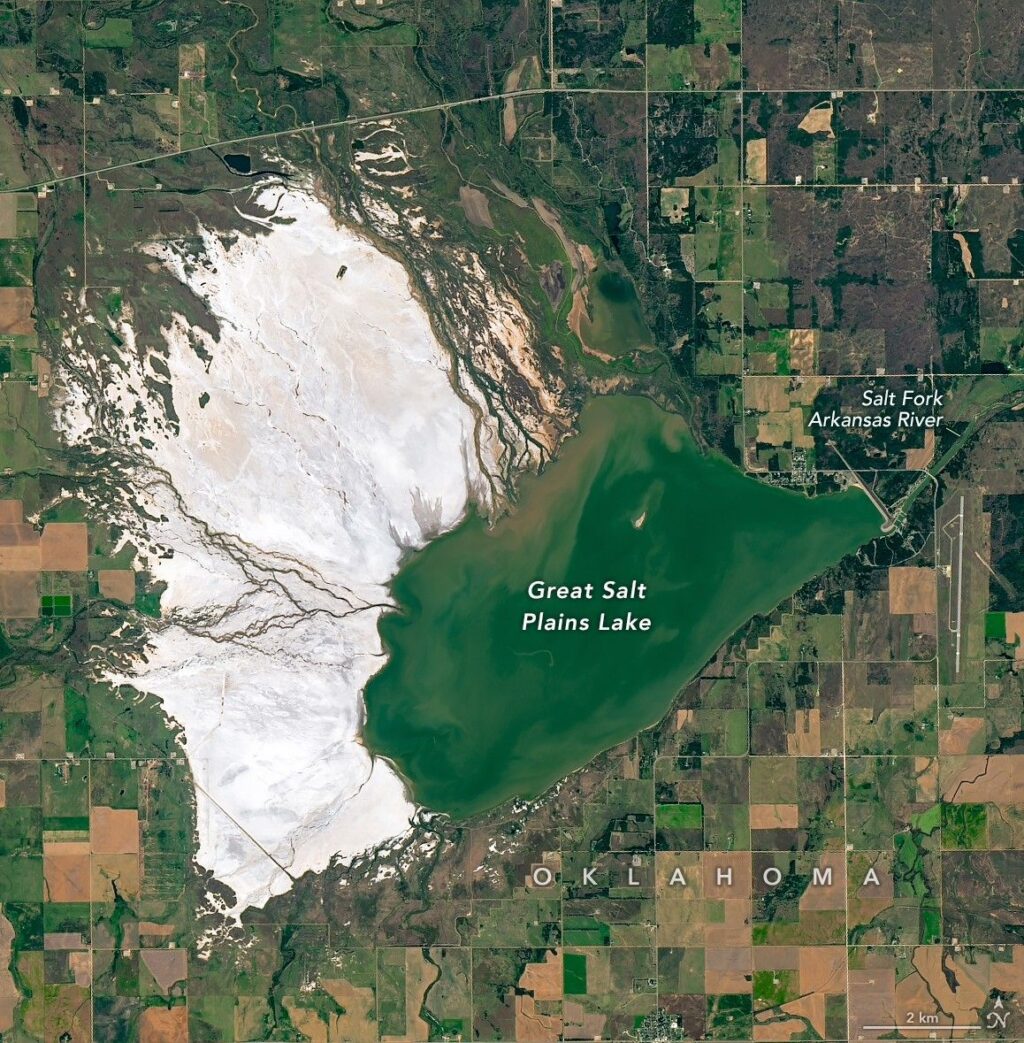
The Great Salt Plains in Oklahoma occupy a roughly triangular area surrounded by agricultural fields. Several streams run through an expanse of bright salt that covers the western side, and a lake with green-tan water fills the eastern corner behind a dam.
October 10, 2025

Dating back centuries, salt-crusted plains in present-day Oklahoma held great value to native tribes and, later, to homesteaders. People used the inland supply of salt in their diets, for tanning deer hides, and for trade. The area also proved to be a fertile hunting ground due to the abundance of game that sought out the nutrient-rich habitat.

Since 1930, the salty deposit located about 90 miles (150 kilometers) northwest of Oklahoma City has been part of Salt Plains National Wildlife Refuge. Today, the plains are still known as a gathering place for diverse animal life, including more than 300 species of birds. But its salt resources have become appealing in another way: it is the only place in the world where people can dig for a distinctively patterned form of crystallized gypsum.

The OLI (Operational Land Imager) on Landsat 8 captured these images of the area in natural color (above) and false color (below) on October 10, 2025. The salt basin is partially filled by Great Salt Plains Lake, a shallow reservoir formed by the damming of the Salt Fork Arkansas River and fed by ephemeral streams.

The false-color image combines the shortwave infrared portion of the electromagnetic spectrum with visible light (OLI bands 7-4-2). In this combination, healthy vegetation appears dark red to purple, and water is blue. The variation in color on the salt plain may be due to different moisture or salinity levels. (Scientists can use shortwave infrared data in estimations of soil salinity.)

In a false-color satellite image of the Great Salt Plains in Oklahoma, salt-crusted areas appear white to light blue and lake water is dark blue to green. Surrounding agricultural areas range from dark purple to light orange.
October 10, 2025

The basin’s salt has its origins in the Permian Period, about 300 million to 250 million years ago. A shallow salt layer from that time still underlies parts of the southwestern U.S., including western Oklahoma. Salt gradually dissolves into groundwater, and when the resulting brine rises to the surface, the water evaporates and leaves behind a bright crust.

The saline water is a key component in a mineral structure unique to the area—hourglass selenite crystals. Selenite, a crystalline variety of gypsum, forms in the top two feet of the wet subsurface when saline water combines with gypsum. The process can occur relatively quickly when temperatures and moisture levels are right. Likewise, crystals may dissolve away if the environment is too wet. Sand and clay particles get incorporated into the otherwise clear crystals, often in a brownish hourglass shape.

Visitors to the Salt Plains scour for these crystal “blades,” but crystal collecting is limited to certain months of the year so as not to disrupt seasonal activities of shorebirds and waterbirds. The salt flats provide habitat and feeding grounds for species such as the snowy plover, sandhill crane, and endangered whooping crane. Other wildlife common to the area include white-tailed deer, red-eared sliders, and nine-banded armadillos.

NASA Earth Observatory images by Michala Garrison, using Landsat data from the U.S. Geological Survey. Story by Lindsey Doermann.

Downloads

The Great Salt Plains in Oklahoma occupy a roughly triangular area surrounded by agricultural fields. Several streams run through an expanse of bright salt that covers the western side, and a lake with green-tan water fills the eastern corner behind a dam.

Natural color, October 10, 2025

JPEG (9.72 MB)

In a false-color satellite image of the Great Salt Plains in Oklahoma, salt-crusted areas appear white to light blue and lake water is dark blue to green. Surrounding agricultural areas range from dark purple to light orange.

False color, October 10, 2025

JPEG (2.99 MB)

References & Resources

  • Johnson, K.S. (1981) Dissolution of salt on the east flank of the Permian Basin in the southwestern U.S.A. Journal of Hydrology, 54 (1–3), 75-93.
  • National Geographic (2020, September 15) Dig in! This nature reserve wants you to make a mess. Accessed March 3, 2026.
  • Oklahoma Historical Society (2010, January 15) Great Salt Plains. Accessed March 3, 2026.
  • Oklahoma Historical Society (2010, January 15) Great Salt Plains State Park and National Wildlife Refuge. Accessed March 3, 2026.
  • U.S. Army Corps of Engineers, Welcome to Great Salt Plains Lake.  Accessed March 3, 2026.
  • U.S. Fish & Wildlife Service, Salt Plains National Wildlife Refuge. Accessed March 3, 2026.

You may also be interested in:

Stay up-to-date with the latest content from NASA as we explore the universe and discover more about our home planet.
Finding Freshwater in Great Salt Lake

4 min read

Reed-covered mounds exposed by declining water levels reveal an unexpected network of freshwater springs that feed directly into the lake…
Article

Lake Eyre Blushes

3 min read

Rounding out a remarkable year, the outback lake displayed distinct green and reddish water in its two main bays.

Article

Dark Skies Over the Great Basin

5 min read

Far from large urban areas, Great Basin National Park offers unencumbered views of the night sky and opportunities to study…


Article

1


2


3


4

Next
Keep Exploring

Discover More from NASA Earth Science

Subscribe to Earth Observatory Newsletters

Subscribe to the Earth Observatory and get the Earth in your inbox.


Earth Observatory Image of the Day

NASA’s Earth Observatory brings you the Earth, every day, with in-depth stories and stunning imagery.


Explore Earth Science


Earth Science Data

The post Searching for Selenite appeared first on NASA Science.

​  

About Author

OTW Observer

See author's posts

Post navigation

Previous Fast Moving Flow…

Related Stories

Smoke Rises Over Big Cypress National Preserve Smoke Rises Over Big Cypress National Preserve
  • Weather Blog

Smoke Rises Over Big Cypress National Preserve

March 3, 2026
Scoria Cones on Earth and Mars Scoria Cones on Earth and Mars
  • Weather Blog

Scoria Cones on Earth and Mars

March 2, 2026
Chesapeake Bay Locked in Ice Chesapeake Bay Locked in Ice
  • Weather Blog

Chesapeake Bay Locked in Ice

February 27, 2026

Recent Posts

Recent Comments

No comments to show.

Archives

  • March 2026
  • February 2026
  • January 2026
  • December 2025
  • November 2025
  • October 2025
  • September 2025
  • August 2025
  • July 2025
  • June 2025
  • May 2025
  • April 2025
  • March 2025
  • February 2025
  • January 2025
  • December 2024
  • November 2024
  • October 2024
  • September 2024
  • August 2024
  • July 2024
  • June 2024
  • May 2024
  • April 2024
  • March 2024
  • February 2024
  • January 2024
  • December 2023
  • November 2023
  • October 2023
  • September 2023
  • August 2023
  • July 2023
  • June 2023
  • May 2023
  • April 2023
  • March 2023
  • February 2023
  • January 2023
  • December 2022
  • November 2022
  • August 2021
  • February 2021
  • June 2020
  • December 2018

Categories

  • All Regions
  • Americas
  • Asia-Pacific
  • Atlantic
  • Caribbean
  • Europe
  • Oceania
  • South China Sea
  • Weather Blog

Weather Media Roundup

Searching for Selenite Searching for Selenite
  • Weather Blog

Searching for Selenite

March 4, 2026
Fast Moving Flow… Fast Moving Flow...
  • Caribbean

Fast Moving Flow…

March 3, 2026
Smoke Rises Over Big Cypress National Preserve Smoke Rises Over Big Cypress National Preserve
  • Weather Blog

Smoke Rises Over Big Cypress National Preserve

March 3, 2026
BBC Weather gives verdict on when bad weather will return after soaring temperatures BBC Weather gives verdict on when bad weather will return after soaring temperatures
  • All Regions
  • Europe

BBC Weather gives verdict on when bad weather will return after soaring temperatures

March 2, 2026

OTW Hosting by Hostinger

Disclosure statement: Links to affiliate products are listed here. Ontheweather.com maybe compensated by displaying and promoting products seen here. Some of the products maybe of interest to you. Learn more about ontheweather.com privacy policy page.

Copyright © All rights reserved. OTW 2024 | DarkNews by AF themes.